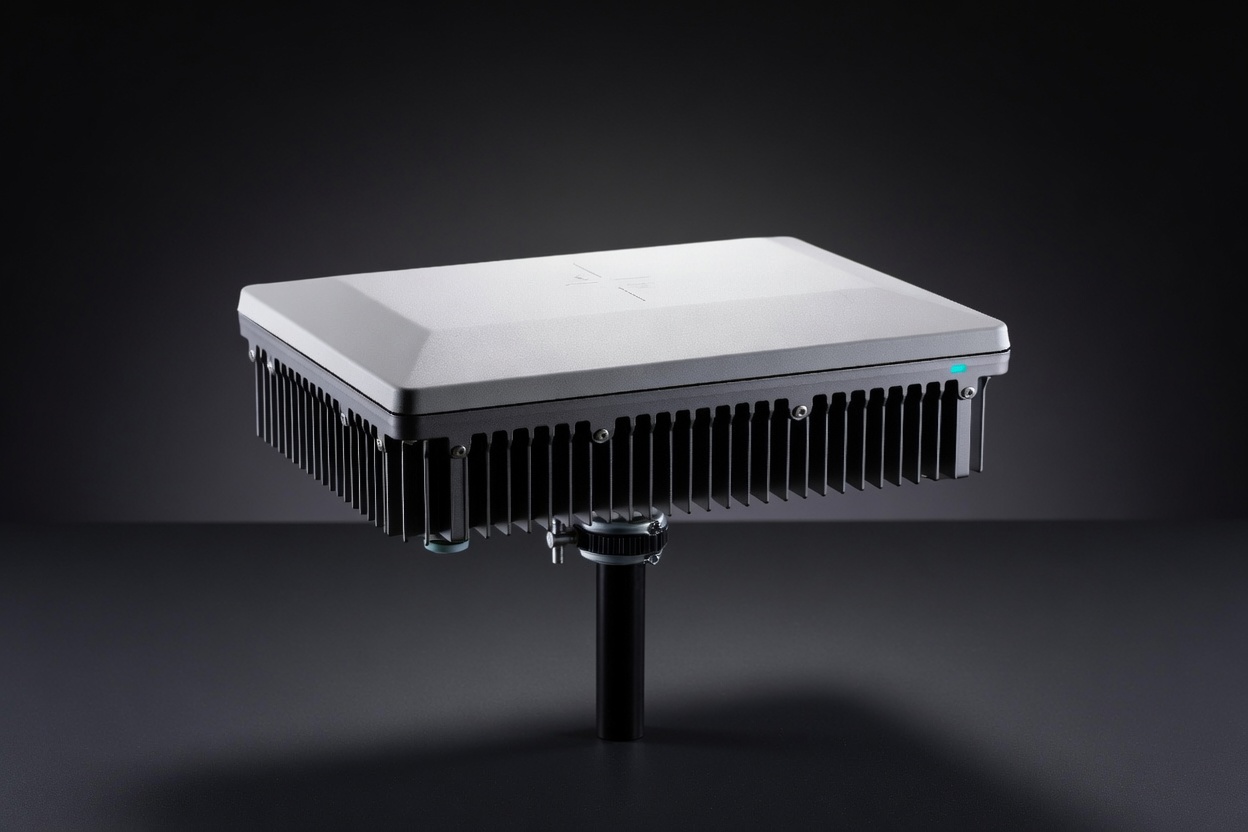
Ranges to every chest sensor and the ball, holds the mesh timebase, and records the match to on-board flash — so the data survives whether or not the venue has working Wi-Fi.
Live when connected. Complete after the match.
6 per pitch
Physical
Envelope
230 × 150 × 66 mmTarget
Mass
≤ 1.35 kgTarget
Sealing
IP67
Operating temperature
−20 to +55 °C
Phase centre
2.5 m
Placement
Corners A1 A3 A4 A6 at 2.3 m ± 0.3 m on the 45° bisector; mids A2 A5 at 5–10 ft off the touch at halfway
RF and timing
UWB channels
Ch5 6.5 GHz + Ch9 8.0 GHz heard at once
Antenna
16-patch squinted array · mechanical ±27° facets · gain predicted pending first articlePlanned
Mesh sync
First-article item — not a published residualPlanned
Storage
Match buffer
≥ 16 GB industrial NAND
Record stamp
Mesh sync time + sensor crypto ID on every record
Stored
Ranging results, quality flags, ball track, goal-beacon poses, pitch survey — not raw RF
Power
Mains
802.3af when a cable exists
Pack
Local cells sized for a match dayTarget
Data paths
Athlete
Burst pull to phone, sensor-ID scoped, 5-minute cooldown
Club
Wi-Fi backhaul drain, optional LTE on gateway role
Live edge (optional)
PoE / Cat6A to PP-C310, Match tier only
Status LEDs indicate role, buffer record/drain, and a mesh-wide dual-ball operations alert.
The anchor hull is not the pitch boundary. The pitch frame comes from the PP-G220 survey.
Figures are engineering targets for the current revision unless labelled otherwise. Patents pending.

 Precision. Performance. Power.